




.svg)

Content
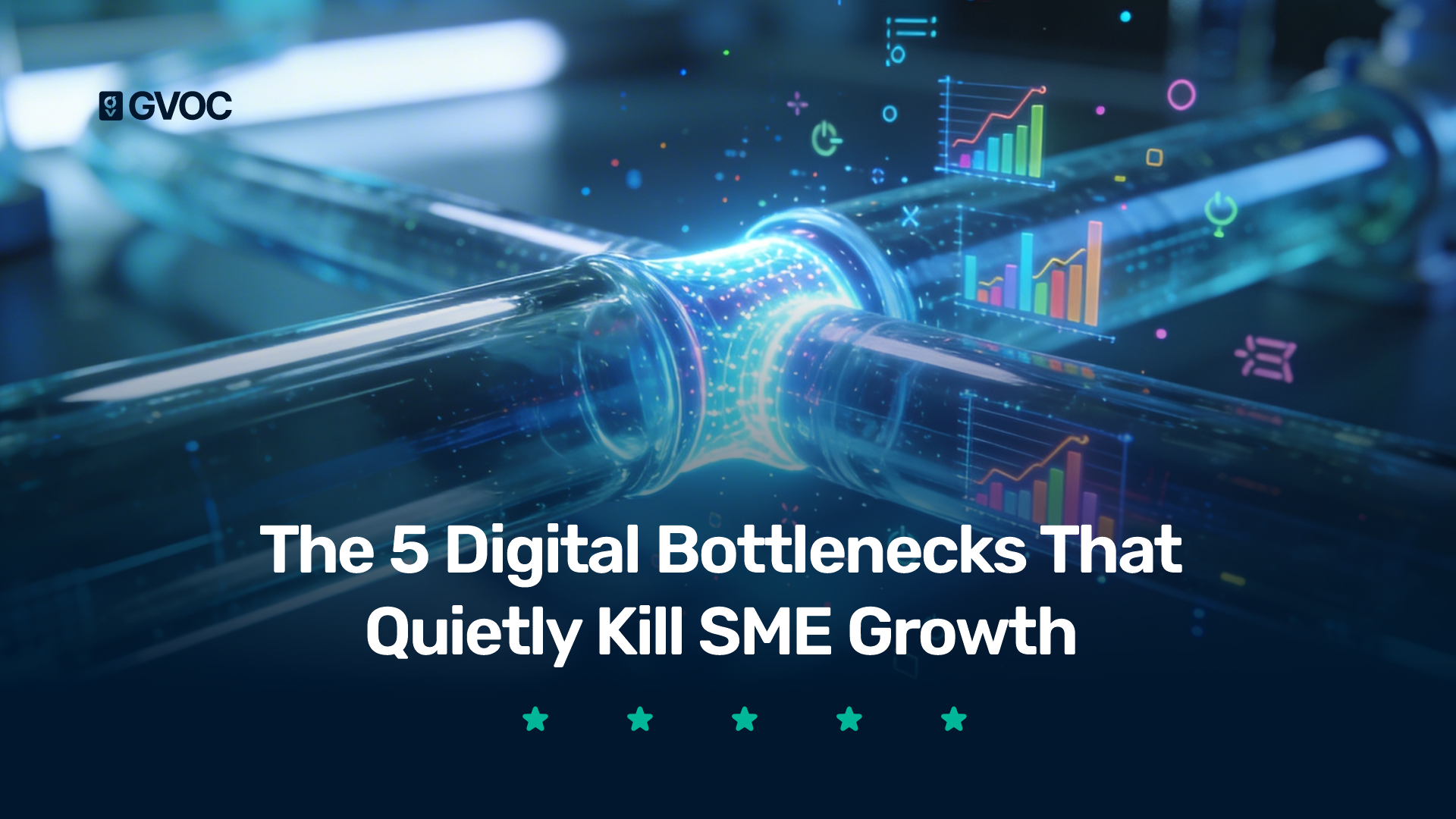
In the mid-market and small enterprise (SME) space, "digital transformation" is often sold as a shiny hardware upgrade. But for us, the reality is far more clinical. growth doesn't usually stall because of a lack of technology; it stalls because of digital friction, the structural drag caused by how data moves through an organisation.
According to the World Economic Forum, while SMEs contribute up to 70% of global GDP, 64% struggle to effectively use the data they already have. Furthermore, IDC research indicates that data silos and fragmentation can cost companies up to 30% of their annual revenue. These are the invisible ceilings that keep a 20-person team feeling like 200 in terms of stress, but 5 in terms of output.
1. The "Human Middleware" Trap
The most pervasive bottleneck in SMEs is the reliance on employees to act as the "bridge" between disconnected systems. We call this Human Middleware. It occurs when a sales rep closes a deal in a CRM, then manually types that same data into an invoice generator, and finally updates a project tracking sheet.
This "copy-paste" workflow is a growth killer. Salesforce reports that AI and automation save sales professionals an average of 2 hours and 15 minutes daily by eliminating manual data entry.
Beyond the time lost, manual entry has an average error rate of 1% to 4%. In a high-volume business, this "bad data" cascades through financial reports, leading to costly reconciliations. Practitioners often mistake "using digital tools" for "being digital." If your tools lack a Functional Integration Layer (APIs), you’ve just moved the paper mess to a screen.
2. The "Month-End" Reporting Lag
If you wait until the 5th of the month to see last month's performance, you are driving a car by looking only at the rearview mirror.
The Harvard Business Review has long advocated for "Real-Time Enterprise" capabilities, noting that the latency between an event and a decision is the ultimate bottleneck in a volatile market.
SMEs often try to solve this by building manual "Master Spreadsheets." By the time the spreadsheet is "cleaned," the data is already stale.
Gartner reports that only 48% of digital initiatives meet their business outcome targets, largely due to poor data timing. To scale, you must move from batch processing to streaming data.
3. Fragmented "Truth" (Data Silos)
Growth requires alignment, but in most SMEs, Marketing, Sales, and Finance work from different datasets. This fragmentation occurs because SMEs grow "opportunistically," buying software for specific problems without a centralized Data Strategy.
Marketing tracks "Leads," Sales tracks "Opportunities," and Finance tracks "Settled Cash," but none of these systems talk to each other.
The solution is centralization. Without a Common Data Model, leadership teams spend meetings arguing about whose numbers are correct rather than how to scale. Centralizing data into a "Single Source of Truth" (SSOT) is the only way to ensure the entire organization moves in the same direction.
4. The Automation "Swiss Cheese" Gap
This occurs when a business automates the middle of a process but leaves the beginning and end manual. For example, a firm might automate lead capture but require a manual "Welcome Call" to trigger the next step. If the Account Manager is sick, the entire automated sequence halts.
Automation is about decoupling scale from headcount. While 74% of employees say automation helps them work faster, many SMEs fail because they automate in fragments rather than flows. If a process requires a human "click" to move to the next stage, that stage is a bottleneck that will break under the pressure of growth.
5. Technical Debt and "Tool Fatigue"
SMEs rely on an average of 10–15 software tools daily, creating "Digital Friction", the cognitive load of switching between apps. There is a constant tension between Best-of-Breed (using the best tool for each task) and All-in-One platforms.
The common error is buying a powerful tool without the technical resources to integrate it, leading to "orphan tools" that hold valuable data no one uses. If you don't have a dedicated Data Engineer, stick to a "Platform First" strategy. Maximise your existing ecosystem (e.g., Microsoft 365) before adding a new vendor that increases your technical debt.
Conclusion
Digital bottlenecks don't look like a server crashing; they look like a talented manager spending Sunday night in Excel.
To grow, an SME must stop viewing IT as a "cost centre" and start viewing Data Flow as a core utility.
By removing the "Human Middleware," centralizing your "Truth," and focusing on End-to-End processes, you create a business that can scale without a linear increase in stress or headcount.
Ready to Remove the Ceiling?
Don't let invisible friction stall your momentum. Turn your data into a strategic asset with expert-led automation and clarity.
Contact GVOC today to audit your digital ecosystem and unlock the next phase of your enterprise growth.


.png)
.svg)

.svg)
.jpg)
.jpg)
.jpg)
.jpg)
.jpg)



Case Studies & Strategies
Dive into our newsletter for a wealth of knowledge in digital marketing


GVOC
rc 15935169
Let's help you understand the Power of Data to Drive Innovation, Enhance Efficiency, and Accelerate Business Growth

Actionable insights for smarter business decisions
Tailored solutions for optimizing performance
Analytics for business growth opportunities
.png)
.png)
.png)
